
HAC-Ed Highlight: Insurance Markets & Single Stair Reform
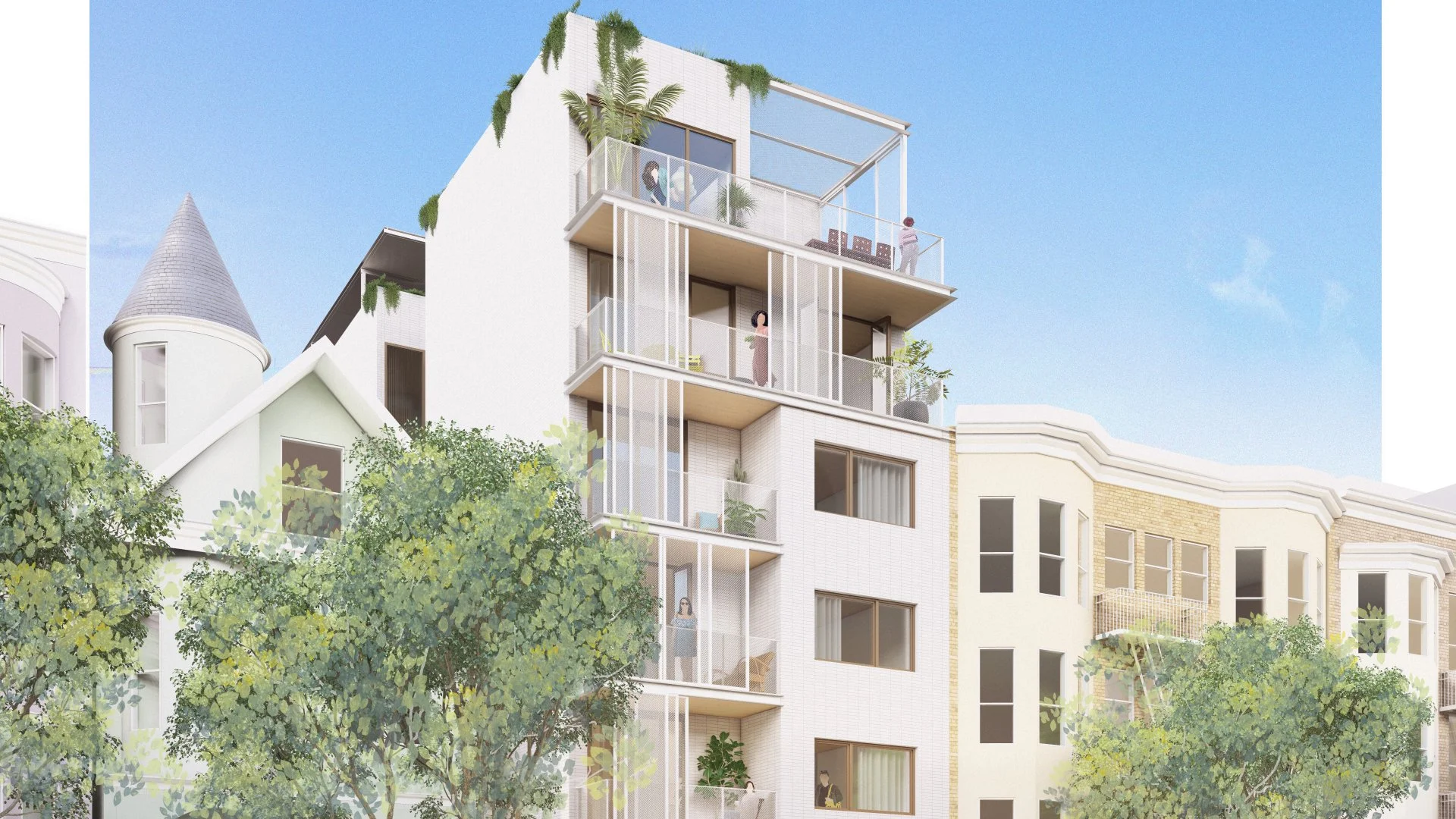
David Baker Architect’s Steplight Project
Our January 14 HAC‑Ed session brought two critical housing barriers to the forefront: insurance markets and building code restrictions. We welcomed back Michael Gunning of the California Building Industry Association (CBIA) to give an update on California’s fire insurance crisis, and heard from HAC’s own Jessie Zwick and Ali Sapirman, who unpacked why reforming the state’s ban on single-stair buildings could unlock thousands of new homes for California families.
Together, the session spotlighted the new bottlenecks that stand between entitled homes on paper and actual homes getting built.
Gunning on Insurance & Where We Are Now
Gunning returned to HAC-Ed with a sobering message: while last year brought some modest legislative wins, insurance remains a quiet but devastating threat to California’s housing goals. Even fully entitled, shovel-ready projects are now getting stalled, not by NIMBY lawsuits or permitting delays, but by the inability to get coverage.
Last year, Gunning described a “perfect storm” of factors upending California’s fire insurance market:
Insurers pulling out of the state
Skyrocketing construction and reinsurance costs
Outdated regulations, especially Prop 103
A strained FAIR Plan meant only as a last resort
Now, we’re finding that California’s Sustainable Insurance Strategy (SIS) is the state’s clearest path forward. While it's not a silver bullet, Gunning emphasized it’s the best tool available to bring insurers back into high-risk markets and stabilize pricing.
Progress includes:
Insurers returning: CSAA, Mercury, and Farmers are among those reentering markets under SIS terms.
New flexibility: Insurers can now use catastrophe models and account for reinsurance costs.
FAIR Plan reforms: AB 226 allows the state to raise private capital, easing pressure on this backstop program.
Still, rollout has been slower than hoped. Regulatory delays mean SIS won’t be fully operational until for a while, and Gunning warned that market stabilization will take at least 1-2 more years.
Meanwhile, the impacts are real:
Condo insurance premiums are up 300-400%, pricing out lower-income buyers.
Common-interest developments (like HOAs) are seeing monthly insurance costs exceed mortgage payments.
Landlords and builders are footing the full cost of structural insurance which also affects rents.
Gunning reiterated: if this market doesn’t recover, the housing pipeline freezes regardless of how many homes we entitle.
HAC on Single Stair: A Smart Step Forward for Infills + Families
From there, we turned to building code reform and one seemingly small change with outsized potential: legalizing single-stair buildings.
Jessie Zwick and Ali Sapirman walked us through the opportunity. Single-stair buildings (common around the world) are banned in most of the U.S. above 3 stories. But where allowed, they:
Enable more family-sized units with better layouts, natural light, and cross-ventilation.
Make small and odd-shaped lots viable for infill housing.
Support sustainability through more compact, passive designs.
They're already legal in Seattle, New York, and Honolulu. California cities like Santa Monica and Culver City have found creative ways to permit them, either via alternate processes or recent code amendments.
But in most of the state, they’re still off-limits, playing a major barrier to low-rise multifamily development on the kinds of parcels California’s cities are now trying to rezone.
HAC and SPUR are co-leading a statewide campaign to legalize single stair construction:
Working towards a bill for the 2026 legislative session to legalize statewide.
Two approaches are being explored: statewide legalization or a local opt-in framework.
HAC is also advocating for a state-funded technical study, similar to one completed in Minnesota, to address safety concerns and build support.
Jessie and Ali noted that the biggest risk is overregulation. As we saw last year in LA, where heavy mitigation requirements essentially erased the benefits of single stair buildings. The goal is to strike a balance: safe, smart, and actually feasible.
Final Takeaway: Clearing the Hidden Blockers
This session made one thing clear: entitlement alone won’t solve the housing crisis. If we want to close the gap between what’s approved and what’s built, we have to take on:
The insurance market dysfunction that’s halting projects midstream
The building code rules that are locking out whole categories of housing
HAC is deeply engaged on both fronts, from Sacramento advocacy to technical education, and we’ll keep you updated as these efforts evolve.
How to Get Involved
Got a stalled project due to insurance? Let us know. We’re tracking these stories to support reform.
Want to support single stair legalization? Reach out to our policy team. Local and statewide allies are key.
Let’s keep unlocking what’s possible and turning pro-housing policy into homes Californians can live in.
