HAC-Ed Highlight: Praxis Group (The Clark on 54th) + Strada / SCB (The Quincy)
What does it actually take to get housing built in California right now? At this HAC-Ed tour session, members got a ground-level answer – twice over. We visited two projects at very different scales, in very different markets, built by very different teams. But both put the same question front and center: how do you make housing pencil when the rules, the capital, and the politics are all working against you?
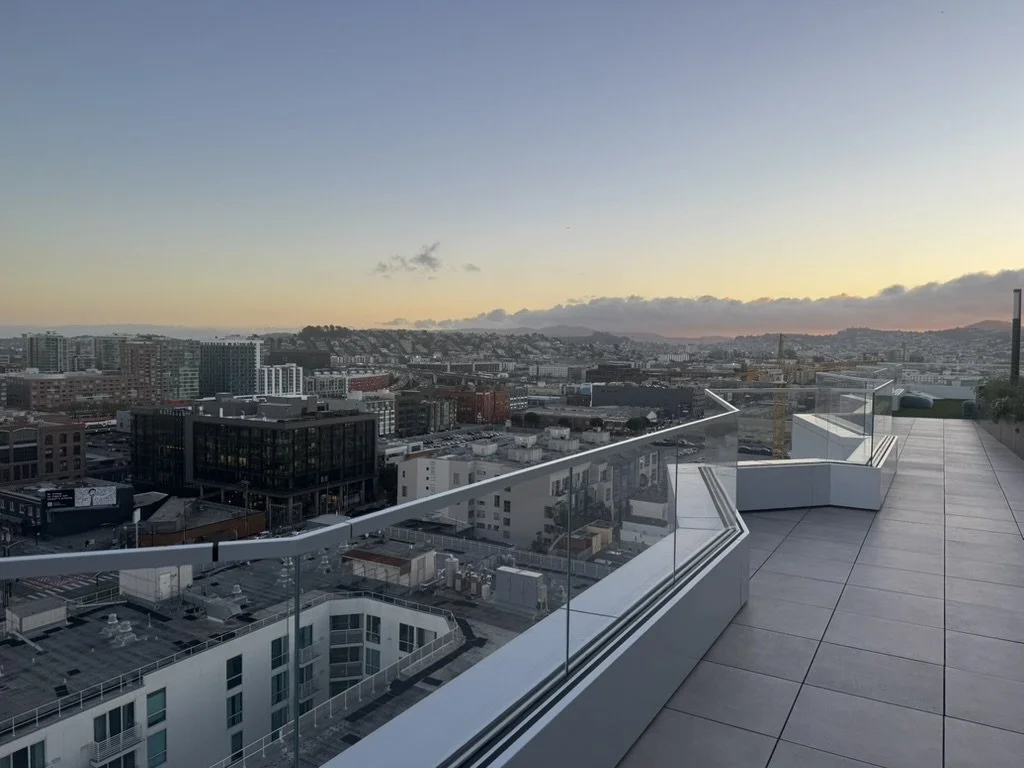
Roof at The Quincy
The Quincy at 555 Bryant (San Francisco)Strada Investment Group | Solomon Cordwell Buenz (SCB) | Swinerton
The Quincy is the kind of project that should be a model. A 501-unit, transit-oriented rental development in SoMa – the only institutional market-rate project being delivered in San Francisco between 2025 and at least 2027. It was entitled under the Housing Sustainability District as part of the Central SoMa Plan, using a process that functioned exactly the way good housing law is supposed to: no CEQA, ministerial approval, 180-day entitlement timeline. Strada also layered in the State Density Bonus, stopping short of the maximum to stay within the streamlined process.
Strada controlled the site in 2020, closed in 2021, broke ground in November 2022, and delivered in May 2025. That's a timeline that almost doesn't exist anymore in San Francisco, made possible precisely because the entitlement process wasn't weaponized. The previous Strada project in the city took four years to entitlement, and this one paints a very different picture.
The building's design was shaped by the site's constraints and the neighborhood's realities. SoMa lacks open space, so SCB designed inward: an H-shaped form with 30-foot-wide interior courtyards that more than half the units face into. All common spaces are flexible and multi-use, designed to run all day. The exterior reads as a hard urban shell that opens to a bright, more generous interior, which the design team described as breaking open a stone to find gold inside.
Financially, the project has performed well. At over 90% leased in 9.5 months, averaging roughly 50 units per month – double the typical pace. The Quincy benefited from a market with almost no vacancy. The 71 affordable units (50% to 110% AMI) have also leased at pace.
A few implementation notes that came up in Q&A: the city required undergrounding utilities along Bryant Street, requiring a temporary overhead power crossing during construction that had to be relocated once work was complete. On unit mix, the project includes 40% two-bedrooms per city requirements, but the team noted that in practice, those units have largely been leased by roommates, not families, raising real questions about whether that requirement is delivering the intended outcome. You can see tour photos here.
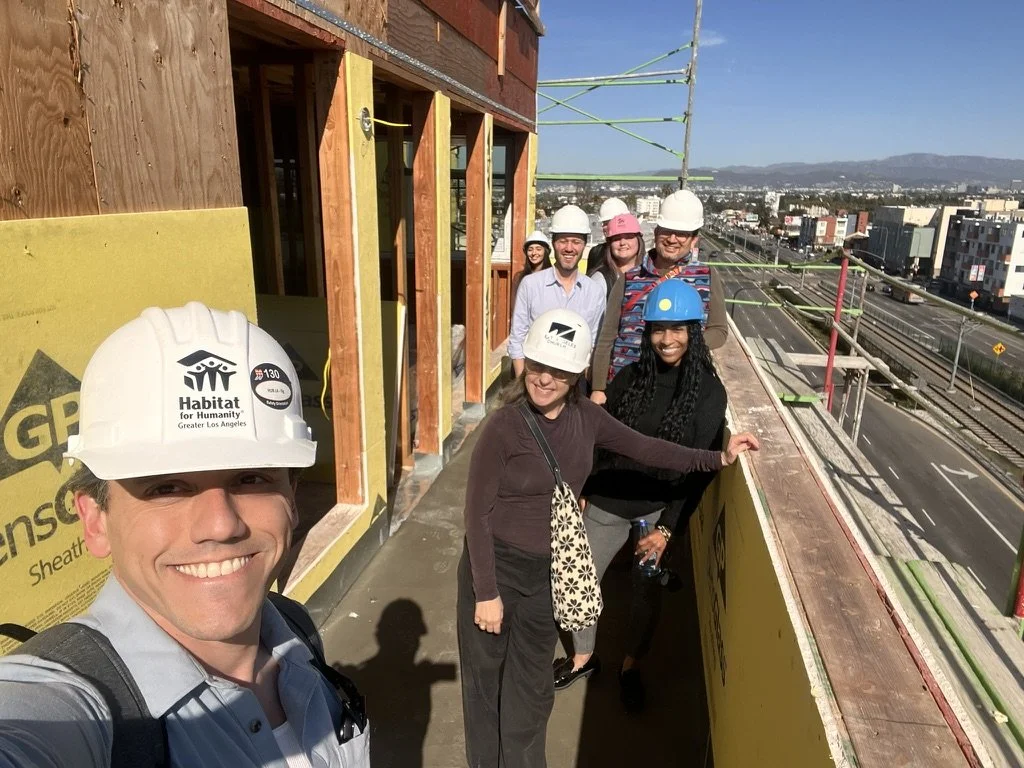
The Clark on 54th (Los Angeles)Praxis Development Group
The Clark on 54th is a 48-unit project at Crenshaw and 54th Street in South Los Angeles, developed by Praxis Development Group in a joint venture with the family that has owned the site since the 1990s. The project pays tribute to their mother, who ran a hair salon on this corner for decades. The building is topped out and on track to open by the end of the year.
The project sits in a historically Black neighborhood adjacent to Leimert Park and View Park/Windsor Hills, surrounded largely by high-value single-family homes and, notably, very little comparable multifamily housing. What exists nearby is either micro-unit rentals or 100% affordable. The Clark will deliver 38 market-rate units and 10 units affordable at 50% AMI, with a unit mix that skews toward family-sized: studios starting at 500 sq ft, 3-bedrooms up to 1,400 sq ft. Outdoor space, a club room, and community-oriented amenities are central to the design.
Praxis was launched in 2019 and has built a model around partnering with families and institutions that own land but lack development expertise. The Clark is the clearest expression of that: the family contributed their land into the joint venture, retaining a substantial ownership share given the land's value. The project also includes a fiscal sponsorship relationship with the California Community Foundation to support the nonprofit and community-benefit components, a structure Praxis is trying to demonstrate and replicate. They've already been approached about a 465-unit project with another family using the same model, with no public subsidy.
The capital stack was hard-fought. Fundraising overlapped with a period of rising interest rates, and the team had to find mission-driven investors – M-Squared, LISC and Genesis LA – willing to back the project. They leveraged approximately 50% debt, brought in grant dollars for community benefits (including a neighborhood mural), and used LV Construction/Six Peak Capital which is both the general contractor and a minority partner, backed by a guarantor Family Office out of London, to make the deal work.
Entitlements predated recent state law changes and took over a year, including three trips through design review. Plan check and other reviews were another additional year. Total development timeline: about three years for a 48-unit project – a timeline the team acknowledged is not scalable. The political environment was mixed: no formal opposition, but limited support from the Council Office or the Mayor's Office, which at the time was focused on Executive Directive 1 (ED1) and prioritizing 100% affordable projects. Praxis also navigated the complexity of being a non-Black-owned developer building in a predominantly Black neighborhood, and noted the shift from initial skepticism to community recognition as the project advanced. You can see tour photos here.
The Throughline
These two projects don't have much in common on paper; one is 501 units of institutional SoMa infill, the other is a 48-unit community-rooted LA project built around a land partnership with a local family. But together they illustrate something important: the barriers to housing production aren't uniform, and neither are the solutions. Streamlined state law made The Quincy possible. The Clark got done through tenacity, creative financing, and mission-driven capital… and even then, it took too long.
Both teams are doing the work. The question HAC keeps pushing on is how to make that work faster, more replicable, and less dependent on heroics.
Call to action: Praxis is actively seeking philanthropic funding and introductions to foundations or institutions with CRA requirements that might support the community benefits component of their projects. All contributions are tax-deductible through the California Community Foundation. Reach out to Brianna at brianna@housingactioncoalition.org if you'd like to connect!